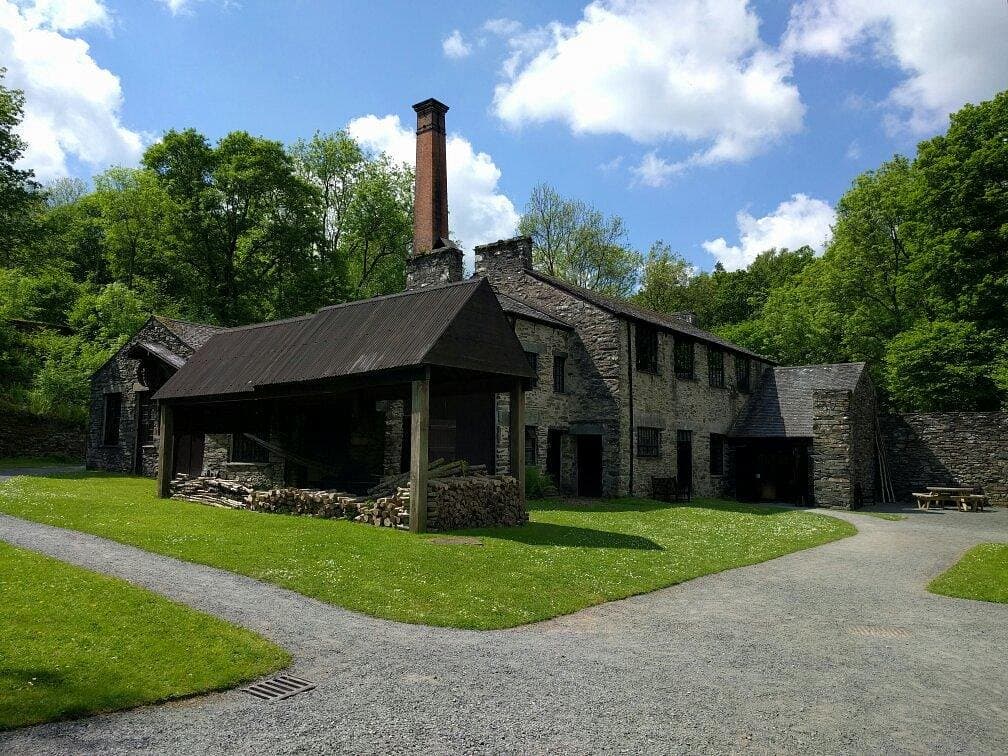
Stott Park Bobbin Mill, next door to Pinewood Cottage
Stott Park Bobbin Mill is next door to Pinewood Cottage — one of the best-preserved pieces of Lake District industrial history.
What you'll see on a tour
English Heritage runs pre-booked guided tours on selected days, usually lasting about 45 minutes. You see the belt-driven machinery at work, the water turbine installed in 1858, and the steam engine that was added in the early 1880s to help out in dry summers. Tours run at set times on open days, and English Heritage has this season's dates.
The guides turn timber from the surrounding woodland into bobbins in front of you, which is the best way to understand how the whole place worked. There is a family trail for younger visitors, a second-hand bookshop on site, and four acres of woodland that are carpeted with bluebells in late April and May. During the October half term the volunteers fire up the boiler and run the steam engine, which is well worth seeing if your visit falls then.
Why a Lakeland valley made bobbins
Bobbin making in the Lake District began in the 1780s, and it grew up alongside the Lancashire textile industry, which needed millions of wooden bobbins to wind its thread and yarn. The Lakeland valleys were ideal, because they had fast water for power and plenty of coppiced woodland for the raw material. At the industry's peak around 1860 there were about 60 mills working in the region, out of more than 100 that opened over the years.
The wood came from coppice woods within roughly 20 miles, mostly alder, ash, birch and willow, cut as poles and left to season for about a year before they reached the lathes. Coppicing is a gentle way of harvesting, because the trees regrow from the cut stumps.
A short history (1835–1971)
John Harrison, a local landowner, built the mill in 1835 on Low Stott Park Farm as a speculative venture. Harrison died in 1843, and the mill then passed through his family while a succession of tenants ran it. From 1864 the Coward family took it on, and in 1921 they bought it outright. The water wheel gave way to a turbine in 1858, fed by water from High Dam, and a steam engine joined it by the early 1880s. Water stayed the main source of power until 1941, when the first electric motor arrived.
As the demand for bobbins changed, the mill turned to other things. By 1900 it was making spout washers, duffle-coat toggles, reels for yarn and wire, and tool handles, and during the First World War the Admiralty was a major customer for toggles. It carried on until 1971, when plastics finally took over, and the mill closed that year.
It was not an easy place to work. Before 1878, boys as young as eight worked in the mills, and long days at repetitive tasks were the norm. The Factory and Workshop Act of 1878 raised the minimum age to ten, with half-time work up to fourteen. A visit gives you a vivid sense of what the work was like.
The mill was soon recognised as important. It was made a Scheduled Ancient Monument in 1973, it opened to the public as a working mill in 1983, and English Heritage has looked after it ever since.
The cottage and the mill
Pinewood Cottage was built to house workers from the mill next door, which is a big part of why staying here feels connected to the site. When you walk out of the gate, you are standing in the same hamlet where generations of mill families lived, and the woods you walk through were once the mill's working coppices.
If you want to know more about how the place got its name and how the lane grew up, our guide to Low and High Stott Park tells that story.
Booking a tour
Book on the English Heritage website before you travel, because walk-ins are not guaranteed on tour days.
Parking at the mill is shared with walkers. Guests at Pinewood Cottage park on the cottage drive (up to three cars), and day visitors should use the official car parks, not the lane or neighbouring areas.
Combine it with High Dam
High Dam, about 0.5 miles (0.8 km) north-west of the mill, is the reservoir that powered it. The High Dam walk is Greenwood Trail Walk 3, and it is one of the loveliest short walks in the south Lakes. You can also try Great Knott Wood or browse the full things to do list.
Your six Swan Hotel spa passes suit a wet afternoon after the mill, and guests with dogs often walk the woodland (see our dog-friendly guide).
Stay next door to the mill
Pinewood Cottage sleeps six, welcomes two dogs and is a few steps from the mill gate. You can check dates on the stay page when you are ready to book.